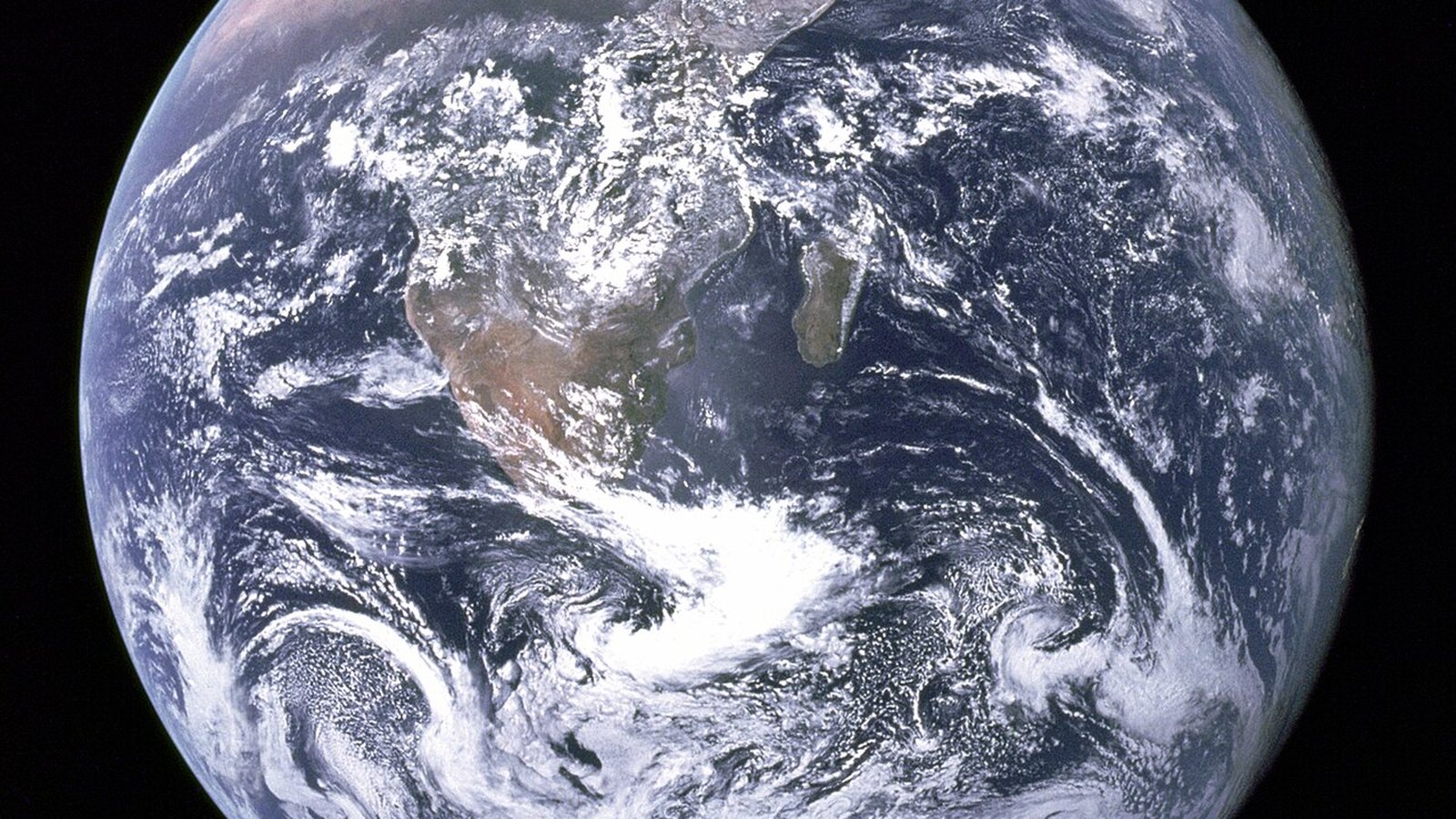
From a few tens of thousands of kilometers out, Earth stops looking like a map and starts looking like a jewel. Oceans dominate. Continents shrink into shapes you half-remember from school. Clouds scribble weather across an entire hemisphere in a single glance.
The famous “Blue Marble” photograph — taken by the Apollo 17 crew in December 1972 — still does something quiet to the mind. There are no country lines. No city lights in that daylight frame. Just a wet, living world wrapped in a film of gas so thin that, drawn to scale, it would be thinner than the skin on an apple.
The atmosphere is almost nothing
Most of the air you breathe sits below about 10–15 kilometers. Mount Everest scrapes near the top of that useful layer. Commercial jets cruise where the sky is already darkening toward black. Above that, pressure falls so quickly that human bodies fail without machines. The cosmos does not begin at some distant border. It begins a short elevator ride above your roof.
We do not live on a planet with space around it. We live in space — briefly sheltered by a soft blue shell.
Astronauts often describe a cognitive shift after seeing Earth this way: the overview effect. It is not mysticism. It is pattern recognition. When every war, harvest, and birthday party you know fits on one lit disk, scale rewrites priorities — at least for a while.
Compare that thin shell to the distances inside the Solar System and the feeling sharpens. The Moon is about 384,000 kilometers away — roughly thirty Earth diameters. Mars, even at a favorable approach, is tens of millions of kilometers farther. Voyager 1 has already crossed into interstellar space, still speaking in a whisper of watts. Against those numbers, the Blue Marble is less a postcard and more a reminder: every ecosystem we argue about shares one closed envelope.
That is why Earth imagery remains political without needing a caption. A single disk makes scarcity visible. Fresh water, arable land, and breathable air stop being infinite backgrounds and become finite surfaces. You do not need a manifesto. You need a clear photograph and a quiet minute.
What the photo still teaches
Satellites now stream Earth imagery constantly. Weather models ingest it. Climate science depends on it. Yet the old Apollo frame retains a power modern dashboards lack: stillness. One image. One orbit. One chance to notice that home is finite.
Diameter: about 12,742 kilometers. Mass: roughly 5.97 × 10²⁴ kilograms. Age: about 4.5 billion years. Those numbers feel abstract until you place them next to a human lifespan, or the width of a city block. Then the marble becomes personal again — not smaller, exactly, but closer.
Tonight, if the sky is clear, step outside. The same planet hangs under your feet. You are already in the picture. You always were.
No Ground.